Showing Your Mastiff
Dog shows are wonderfully fun for those people wanting to participate in a leisure activity with their dog. It’s also a great place to meet other people with similar interests. Whether you are competitive or just there to have fun there is something for everyone, even junior handling for kids. Get out there and show off your fabulous dog!
During the process of working with and training your dog you will foster a strong bond and become a team. Handling your dog in the ring yourself can be a very rewarding experience. Training classes offer the best hands-on way to practice and attending shows and observing your breed is also a great way to gain a better understanding of what to expect at a show. Dogs must be at least six months of age to enter any events. If you do not wish to handle your dog yourself, you can hire a professional handler who charges a fee for showing your dog.
Exhibiting your dog at shows is a fun hobby that can grow into quite a habit!
Shows are held all across the country year round. To find all the upcoming events visit Canuck Dogs
During the process of working with and training your dog you will foster a strong bond and become a team. Handling your dog in the ring yourself can be a very rewarding experience. Training classes offer the best hands-on way to practice and attending shows and observing your breed is also a great way to gain a better understanding of what to expect at a show. Dogs must be at least six months of age to enter any events. If you do not wish to handle your dog yourself, you can hire a professional handler who charges a fee for showing your dog.
Exhibiting your dog at shows is a fun hobby that can grow into quite a habit!
Shows are held all across the country year round. To find all the upcoming events visit Canuck Dogs
The conformation ring
Behind all the fun, there is a serious purpose to conformation dog shows…evaluation of breeding stock. Dogs are being judged against the written breed standard which takes into consideration physical characteristics as well as correct temperament and movement. However, not everyone who is involved in showing will breed, some do it just for fun.
Each breed is judged separately, first the males in order of age with the youngest first, then the female classes. Last to go are the specials (dogs that already have their championship). Visit our glossary of dog show terms to learn the "lingo".
In each class dogs are brought into and moved around the ring so the judge can evaluate their movement. Handlers then stand their dogs in profile. The judge will examine the dogs individually, checking for things such as correct structure, head shape, expression, coat qualities, length of ears and tail, the alignment of the teeth, body proportions, shoulder and pelvic angles, topline, and male dogs are checked for the presence of two testicles. Dogs are moved individually, then together so the judge can compare them. The judge will award 1st through 4th placements for each class. The winner of each class is brought back into the ring to compete for winners dog and winners bitch (only the winners dog and bitch will accumulate points towards their championship). The last class is for the specials along with the winners dog and winners bitch who will all compete for the coveted Best of Breed award.
Each breed is judged separately, first the males in order of age with the youngest first, then the female classes. Last to go are the specials (dogs that already have their championship). Visit our glossary of dog show terms to learn the "lingo".
In each class dogs are brought into and moved around the ring so the judge can evaluate their movement. Handlers then stand their dogs in profile. The judge will examine the dogs individually, checking for things such as correct structure, head shape, expression, coat qualities, length of ears and tail, the alignment of the teeth, body proportions, shoulder and pelvic angles, topline, and male dogs are checked for the presence of two testicles. Dogs are moved individually, then together so the judge can compare them. The judge will award 1st through 4th placements for each class. The winner of each class is brought back into the ring to compete for winners dog and winners bitch (only the winners dog and bitch will accumulate points towards their championship). The last class is for the specials along with the winners dog and winners bitch who will all compete for the coveted Best of Breed award.
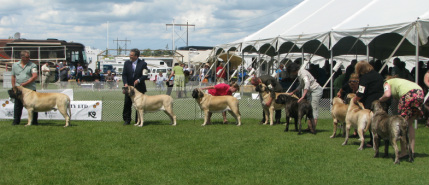 Canadian Mastiff Club National Specialty Show. Calgary 2012. |
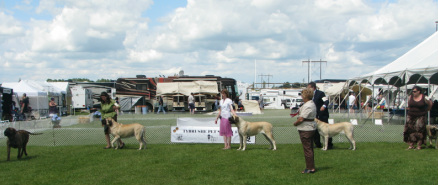 |
Showing a dog is a great way to learn about the breed standard, structure and movement.
To attain a championship title in Canada, ten points must be awarded by at least three different judges and include at least one win of 2 or more points. The number of dogs competing determines the number of championship points that will be allotted to the winner, up to a maximum of five points per show.
The dog that was awarded Best of Breed now will compete at the group level (the mastiff is included in the working group). All the best of breed winners from each of the breeds in the working group compete for 1st through 4th placements. The dog that places 1st in each group goes on to compete for the prestigious title of Best in Show. The best puppy of each breed competes for the title of Best Puppy in Group, then on to Best Puppy in Show.
To attain a championship title in Canada, ten points must be awarded by at least three different judges and include at least one win of 2 or more points. The number of dogs competing determines the number of championship points that will be allotted to the winner, up to a maximum of five points per show.
The dog that was awarded Best of Breed now will compete at the group level (the mastiff is included in the working group). All the best of breed winners from each of the breeds in the working group compete for 1st through 4th placements. The dog that places 1st in each group goes on to compete for the prestigious title of Best in Show. The best puppy of each breed competes for the title of Best Puppy in Group, then on to Best Puppy in Show.
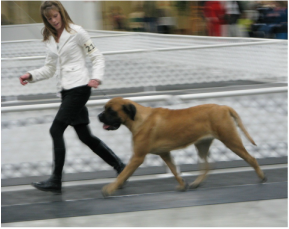
Sedona showing off her movement. Camrose 2009.
|
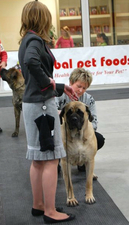
Dora getting examined by the judge, Red Deer 2010.
|
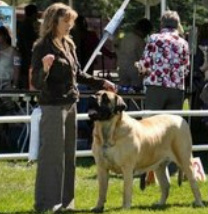
Echo in the breed ring. Edmonton Kennel Club 2010.
|
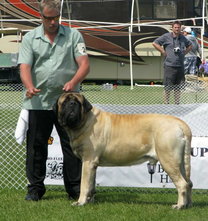
Chuma in Calgary 2012.
|
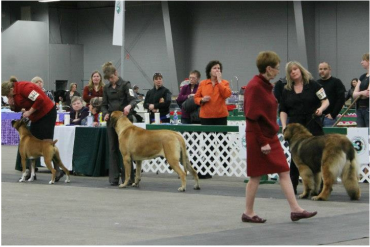
Cinder in the group ring, Camrose 2013.
|
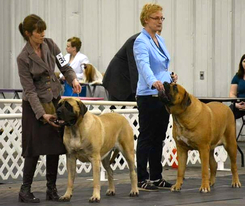
Journey and Ember in Red Deer 2015
|
Rally Obedience
This is a less formal version of traditional obedience trials. A number of “stations” are set up and the handler is able to walk the course before the trial begins. At each station the handler will get their dog to perform a specific exercise. Praise, double commands and lots of encouragement are allowed. You can even repeat an exercise if you didn’t get it right the first time, without being disqualified (but you will lose some points).
There are three levels: Novice, Advanced and Excellent. At the novice level there are 31 different exercises from which the judge will select between 10 – 15 for the trial. Each trial will be scored from 0 to 100. A qualifying score is 70 or greater, and 3 qualifying scores will earn you a rally title.
There are three levels: Novice, Advanced and Excellent. At the novice level there are 31 different exercises from which the judge will select between 10 – 15 for the trial. Each trial will be scored from 0 to 100. A qualifying score is 70 or greater, and 3 qualifying scores will earn you a rally title.
Canine Good Neighbor
This is a non-competitive test that assesses the handler and the dog’s relationship, along with the handler’s ability to control the dog. There are a series of 12 exercises that will demonstrate the ability to perform basic commands and good manners in everyday situations.
The purpose of the test is to encourage responsible dog ownership and ensure that our companion is accepted as a valued member of the community.
The purpose of the test is to encourage responsible dog ownership and ensure that our companion is accepted as a valued member of the community.
|
The exercises are:
1 Accepting a friendly stranger 2 Politely accepts petting 3 Appearance and grooming 4 Out for a walk 5 Walking through a crowd 6 Sit/Down on command and stay in place 7 Come when called 8 Praise/Interaction 9 Reaction to a passing dog 10 Reaction to distractions 11 Supervised Isolation 12 Walking through a door/gate |
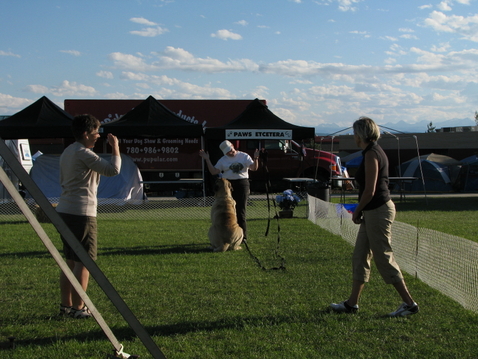 Winston completing his CGN and becoming the first Mastiff to attain a Grand Championship title in Canada. |
Dog show etiquette for spectators
Always ask before touching a dog - this includes children. Some breeds take many hours of grooming to prepare for the show ring and others may be nervous if they are just being introduced to the dog show environment.
Most participants love to talk about their dog and their breed. It is courteous to ask if it's a good time to talk.
Most participants love to talk about their dog and their breed. It is courteous to ask if it's a good time to talk.
More Info
If you have questions about showing a mastiff or would like to meet up at a dog show please get in touch.